
From Chatbots to AI Agents: What Actually Changed?
Over the past year, the industry quietly rewrote its vocabulary.
What we once called chatbots are now labeled AI agents. Vendors speak of autonomy. Platforms speak of orchestration. Startups speak of self-directed systems that reason, plan, and act.
It sounds like a categorical leap.
But before we accept that framing, it is worth asking a harder question, one the demos rarely invite:
Did AI fundamentally change or did system design evolve around it?
The answer matters more than the label.
The Comfortable Narrative
The standard version of this story goes like this.
Chatbots answer questions. Agents take action. Chatbots are reactive. Agents are proactive. Chatbots generate text. Agents reason, plan, use tools, and execute tasks across systems.
In technical terms, the leap is explained through three additions: tool usage, memory, and planning. With modern large language models enabling function calling and structured outputs, the argument feels persuasive. If a model can understand intent, select a tool, execute it, evaluate the result, and iterate to completion, surely we have moved beyond chat interfaces.
On paper, that is true.
But enterprises do not operate on paper.
The Actual Difference
Here is the claim this piece is making plainly:
The difference between a chatbot and an AI agent is not autonomy. It is exposure to operational surface area.
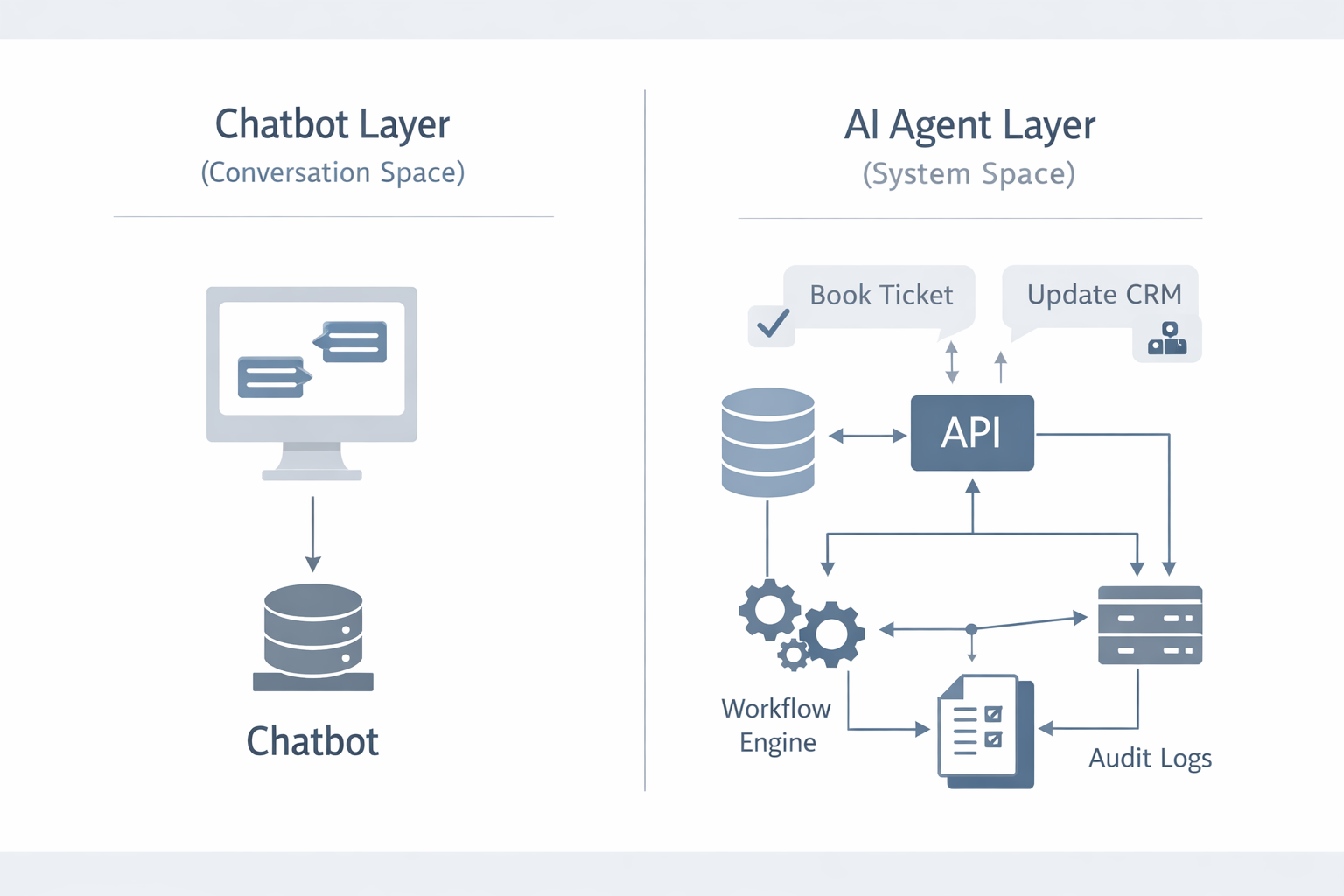
A chatbot mostly lives in conversation space, bounded, ephemeral, low stakes if wrong. An agent lives in system space, where it touches APIs, modifies records, triggers workflows, and propagates errors silently across integrated environments.
That difference is not a cognitive upgrade. It is an architectural one.
In a controlled demo, an agent has clean APIs, deterministic tool outputs, clear objectives, and no competing priorities. In a production enterprise environment, the same system encounters:
- Partial or inconsistent data states
- Conflicting permissions across integrated systems
- Latency that breaks multi-step assumptions
- Audit requirements the model was never designed to satisfy
- Human override needs the orchestration layer did not anticipate
And suddenly, autonomy stops being impressive. Because autonomy without constraint is not intelligence. It is unmanaged variance at scale.
Three Things That Actually Changed
None of the following are mystical. None justify the narrative leap that vendor positioning implies. But they are real, and they matter.
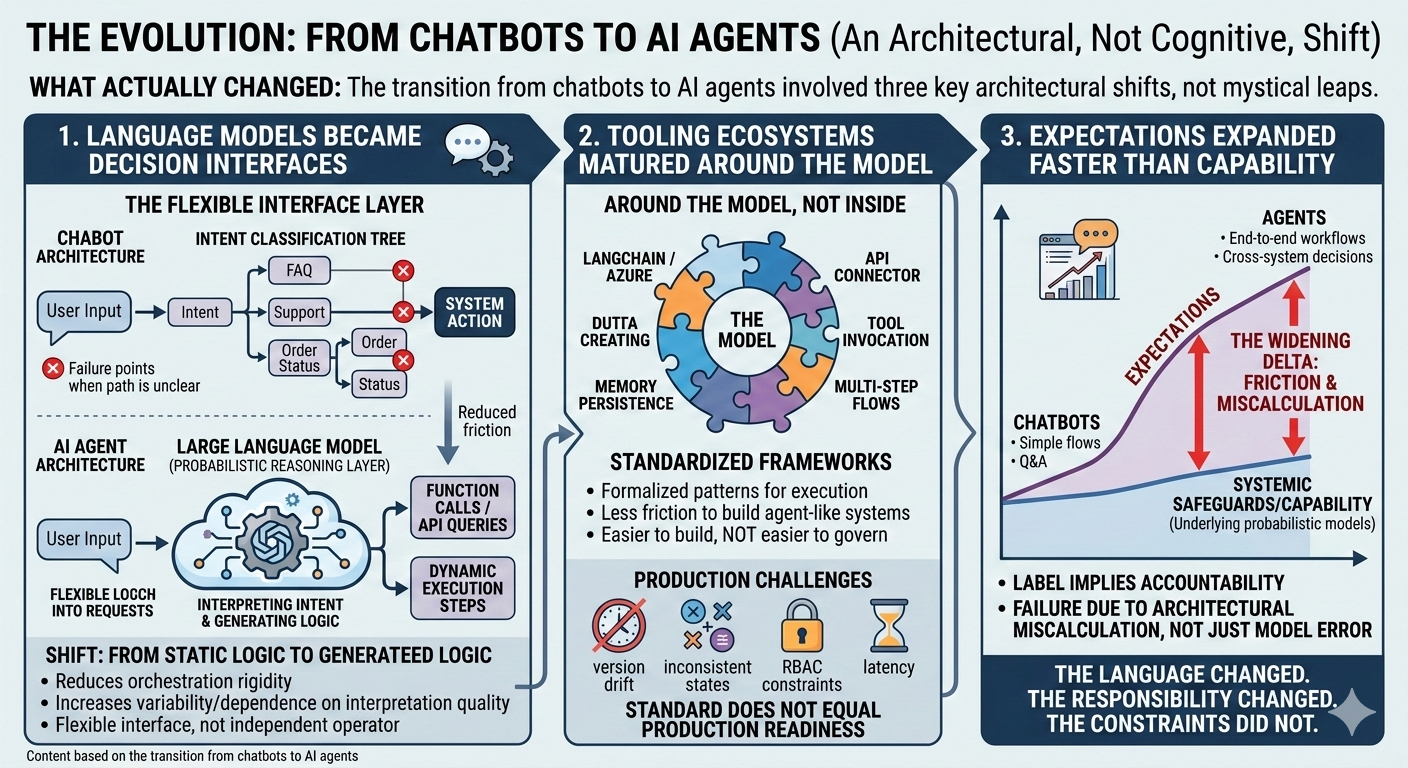
Language models became decision interfaces, not just generation engines.
Earlier chatbots relied on rigid intent classification and predefined conversational paths. When input fell outside the expected pattern, the system failed abruptly and visibly. Modern LLMs replaced that with probabilistic reasoning. A model can now interpret loosely structured instructions, infer intent without rigid schemas, and dynamically decide which function to call or which system to query.
This reduced orchestration rigidity significantly. But it did not reduce orchestration complexity.
What changed is where variability now lives. Static logic was predictable in its failures. Generated logic fails differently each time, which makes it harder to anticipate, harder to audit, and harder to explain when something goes wrong in production. The model became a flexible interface layer between humans and systems. Not an independent operator.
Tooling ecosystems matured around the model, and made agents easier to build, not easier to govern.
Frameworks like LangChain, and enterprise platforms from Microsoft and Google, formalized patterns for tool invocation, memory persistence, and multi-step execution. What was once improvised through custom scripts became standardized. The barrier to constructing an agent dropped significantly.
This is where the confusion enters.
Standardization creates the impression of production readiness. It is not the same thing. Once deployed into enterprise environments, these systems must contend with API version drift, inconsistent system states, role-based access constraints, logging requirements, and regulatory audit trails. The framework simplifies orchestration logic. It does not absorb operational responsibility. That responsibility simply moved, from the tooling to the team deploying it.
Expectations expanded faster than capability, and that gap is where most implementations fracture.
When we called them chatbots, expectations were bounded. Failure was tolerated because scope was limited. The moment we began calling them AI agents, the implied contract changed. An agent is expected to complete workflows end to end, manage edge cases, resolve ambiguities, and operate with meaningful independence. The label carries operational weight.
But the underlying model remained probabilistic.
The technology improved incrementally. Expectations accelerated exponentially. And when expectation outpaces safeguards, the failure mode is not a model error. It is an architectural miscalculation. The label changed. The responsibility changed. The constraints did not.
The Thing That Never Changed
Beneath every agent loop, one thing remained constant.
The core model still predicts the next token.
Planning is generated. Tool selection is generated. Self-correction is generated. Even the most sophisticated multi-agent orchestration reduces, at every node, to a probabilistic inference over a token distribution.
This is not a weakness to dismiss. But it is a constraint that cannot be designed away.
In enterprise environments, that constraint has a specific name: non-determinism risk. It manifests as audit gaps when an agent takes a path that cannot be reconstructed. It manifests as compliance exposure when a generated decision cannot be explained to a regulator. It manifests as reproducibility failure when a workflow that succeeded last Tuesday fails silently this Thursday with no clear reason why.
Upgrading the label from chatbot to agent did not resolve this tension. It amplified it. Because now the same probabilistic system is operating inside consequential workflows, with organizational accountability attached to its outputs.
What Enterprises Should Actually Be Designing For
The organizations getting enterprise AI right are not the ones chasing autonomy. They are the ones designing around a more precise question:
How much operational responsibility can we safely delegate to a probabilistic system, and what does "safely" require us to build?
That question forces a different conversation than capability benchmarks do. It leads to bounded autonomy rather than open-ended agency. It leads to constrained execution paths rather than fully generative decision-making. It leads to observable action trails, human-in-the-loop checkpoints, and clear decision rights over what the model can and cannot do unilaterally.
The most effective enterprise AI agents today are not fully autonomous. They are carefully supervised orchestrators, systems where the model handles interpretation and selection, while the architecture handles accountability.
Hybrid systems outperform pure autonomy in production. Not because of technical limitations. Because enterprises optimize for survivability, not spectacle.
Closing
The transition from chatbot to AI agent is real.
But it is not a leap in intelligence. It is a shift in exposure, and an acceleration in accountability.
A chatbot that hallucinates is embarrassing. An agent that hallucinates inside a procurement workflow, a compliance system, or a customer data pipeline is a different category of problem entirely.
The industry changed the label. The organizations that will scale this technology successfully are the ones who understood that changing the label also changed the failure stakes, and designed accordingly.