The Real Cost of an AI Tool Is Not Its Licence Price
The cheapest AI tool on a procurement sheet can still become the most expensive tool in the workflow.
I did not notice this because of a pricing model. I noticed it because of retries.
A task would look simple. I would send it to the tool already available to me. The first answer would be almost right. So I would clarify the prompt. Then add more context. Then attach another file. Then try a new conversation. Sometimes I would eventually get the result. Sometimes I would move the task somewhere else.
The licence had not changed.
The cost of completing the task had.
We are very good at pricing access to AI. We are much worse at pricing the effort required to make that access useful.
The licence price is the easiest number in the room
There is a reason organisations naturally start with licence cost.
It is visible.
A platform costs a certain amount per user. An API has a token rate. A subscription includes a defined allowance. Procurement can compare one number with another, negotiate it, approve it, and eventually put it into a budget.
That logic works reasonably well when the relationship between usage and output is predictable.
AI makes that relationship less clean.
Two people can have access to the same tool and create very different cost profiles. One gets an acceptable result in a single interaction. Another goes through multiple attempts, adds larger context windows, changes models, rewrites prompts, and eventually moves the task elsewhere.
The visible cost is still one licence.
The operational cost is not.
Completion cost is a different number
I think the more useful unit is not always cost per licence or even cost per token.
It is closer to cost to reach an acceptable outcome.
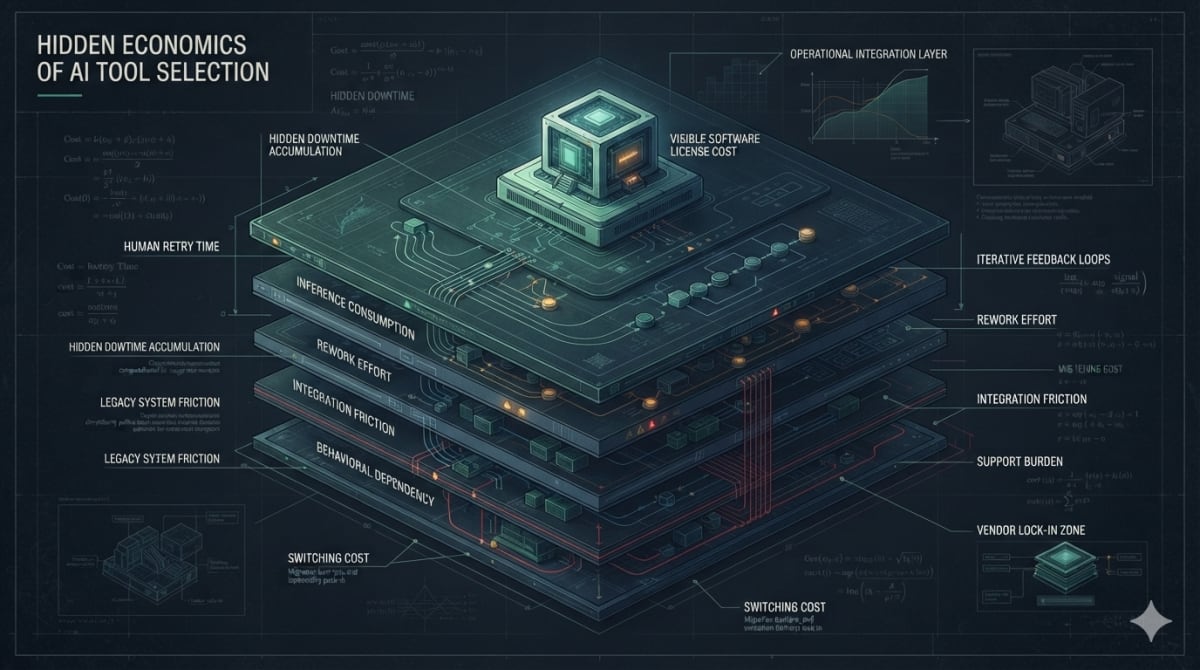
That cost can contain several things at once:
• Access cost: the licence, subscription, API, or platform charge.
• Inference cost: tokens, credits, or compute consumed while producing the output.
• Human retry cost: the time spent rewriting prompts, adding context, checking answers, and trying again.
• Rework cost: what happens when an output looks finished but creates problems downstream.
• Switching cost: the effort involved in moving the task, process, or team to another tool after the original choice stops working.
None of these automatically make a more expensive product cheaper.
But they make the original comparison less obvious.
If Tool A costs less but repeatedly requires more intervention, while Tool B costs more but completes the same class of task with less human effort, the relevant economic question is no longer which licence is cheaper.
It is which system produces the outcome at a lower total cost.
The retry loop is economically awkward
The hardest part is that retry behaviour feels free while it is happening.
One more prompt does not feel like a budget decision.
Adding another document does not feel like infrastructure spend.
Asking the same model again with better wording feels like normal knowledge work.
Individually, each action is small. At scale, they become a pattern.
A hundred employees each spending another ten minutes trying to rescue a poor interaction is not an AI cost in most reporting systems. It is just work.
That separation is convenient for accounting and dangerous for understanding productivity.
A model can look cheap because part of its cost is being paid in employee attention.
Bundling makes the economics even harder to see
Bundled platforms create another distortion.
If an AI capability already arrives inside a broader enterprise agreement, the marginal licence cost may appear negligible. That makes the default economically attractive before the use case has even been examined.
And sometimes that is absolutely the right answer.
If the work is simple, the tool is already governed, the employees know how to use it, and the output is good enough, introducing another platform may create more cost than it removes.
But “already paid for” is not the same as “free.”
The organisation has simply moved part of the economic decision somewhere else.
The cost may appear later as longer completion time, integration workarounds, extra review, weaker output, or dependency on one ecosystem.
Dependency has an economic shape
This is where the cost question becomes architectural.
When one tool becomes the default for most work, the organisation accumulates more than usage.
People learn its interface. Prompts are written around its behaviour. Processes start assuming its capabilities. Integrations are built around its ecosystem. Support models are designed around it.
Each of those decisions makes the next decision easier.
That is useful standardisation.
It is also how switching cost compounds.
If the vendor raises prices, changes limits, removes a feature, or simply stops being the best fit for a particular workload, the cost of moving is now much larger than the difference between two licences.
The organisation has to move behaviour as well as technology.
This does not mean every organisation needs ten tools
The obvious counterargument is complexity.
A portfolio of specialised tools can become expensive very quickly. More vendors mean more procurement, more security review, more contracts, more integration paths, more training, and potentially more confusion for users.
There is also value in consistency.
A standard platform can reduce support effort, simplify governance, and give employees a common interface. Those benefits are real and should not be treated as laziness.
So the economic tension is not “one tool is bad, many tools are good.”
It is closer to this:
How much inefficiency should an organisation accept in exchange for standardisation, and at what point does standardisation become expensive dependency?
The portfolio probably needs a default and an escape route
The setups that seem more durable do not eliminate defaults.
They make the default explicit.
A broad productivity assistant may remain the first choice for ordinary work because the convenience is economically valuable. But some classes of work have a reason to leave that default.
A coding workload may justify a specialist development tool. A deterministic process may belong in workflow automation. Enterprise knowledge retrieval may require a platform designed around internal search. A sensitive workload may be constrained by governance or residency before model quality is even considered.
The point is not tool abundance.
It is having a reason for the exception.
This changes what AI Tool Fit is actually measuring
In the first post, I introduced AI Tool Fit as an attempt to move tool selection before the retry loop.
The economic layer makes that idea more interesting.
A high capability match does not automatically create the best business case.
A tool might fit the requirement extremely well but require a new enterprise agreement, significant integration work, or specialist skills that make it uneconomic for the size of the use case.
Another tool may be slightly weaker technically but already governed, integrated, and licensed.
That means fit and economics cannot be collapsed into the same number without losing something important.
I would rather keep them visible as separate questions:
• Capability fit: can this tool do the work under the stated requirements?
• Economic fit: does the cost of using, operating, and eventually changing this tool make sense for the value of the use case?
That distinction is something I want to build further into the framework rather than pretending one confidence score can answer both.
The cheapest architecture may not have the cheapest component
This is the part that changes how I think about AI procurement.
The unit being optimised should probably not be the subscription.
It should be the workload.
For some workloads, the bundled default will win easily.
For others, paying more for a specialist tool may reduce enough retries, rework, and operating friction to make the overall system cheaper.
And sometimes the best economic answer will be not to introduce another AI tool at all.
The difficult part is that most of those costs become visible only after people have already adapted their work around the tool.
If the licence is the only AI cost an organisation can clearly see, how confident can it really be that it knows what its AI is costing?