Why Cloud-Only AI Breaks at the Edge
The first time I saw an AI system fail in a way that had nothing to do with the model, I spent two days looking in the wrong place.
The model was fine. The inference was accurate. The problem was that by the time the decision arrived, the moment it was supposed to act on had already passed.
That is not a model problem. That is an architecture problem. And it is the kind of problem that does not show up in demos, because demos do not have millisecond sensitive rejection mechanisms, intermittent field connectivity, or data residency obligations that stop your telemetry at a national border.
Cloud first AI is not wrong. It is just designed for a different reality than the one most operational environments actually live in.
What the Default Assumption Gets Right
The cloud first model makes genuine sense for a large class of enterprise AI work. Centralised compute, centralised governance, centralised observability. Data flows up, decisions flow down. For analytical workloads, this is not just convenient, it is genuinely the right architecture.
Customer segmentation, fraud analytics at rest, enterprise copilots, reporting automation: none of these have a physics problem. The data can afford to travel. The decision can afford to arrive a second later. The network can be assumed to be reliable because the consequences of a brief outage are recoverable.
The industry narrative built on top of this was reasonable. Collect everything, centralise the intelligence, push instructions back out. For a long stretch of enterprise AI deployment, that loop worked.
The problem is that the loop was never designed for environments where physics intervenes.
Where the Architecture Starts to Break
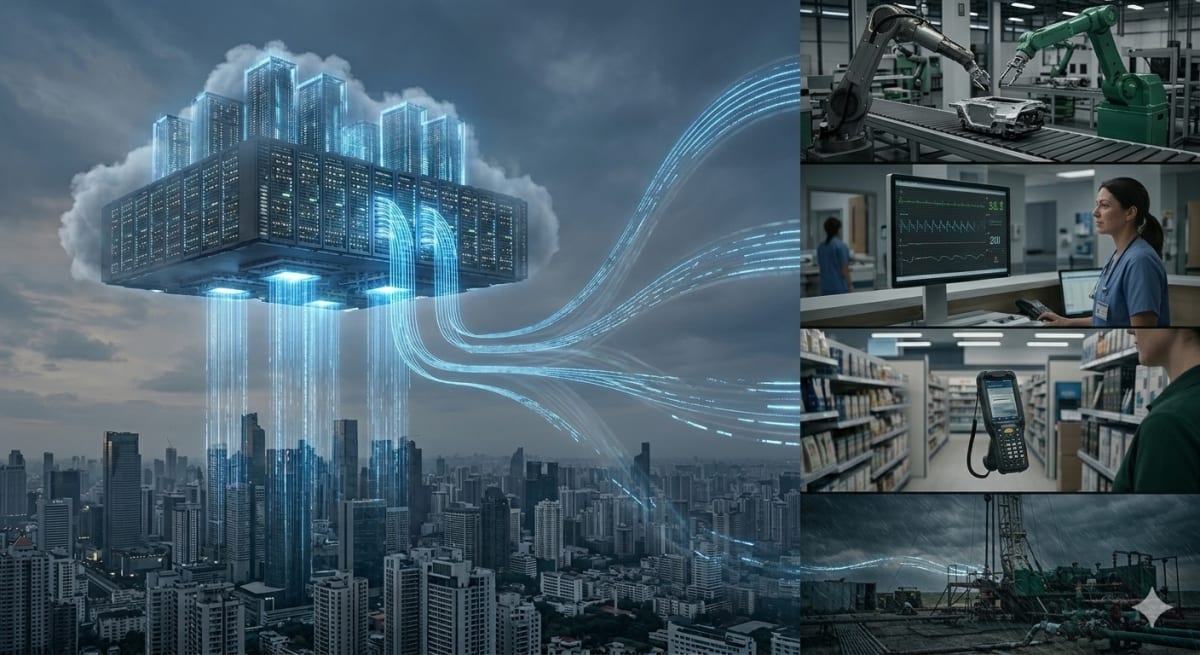
Move AI from dashboards into operational environments: factories, energy grids, remote field sites, hospital floors and the constraints that cloud diagrams quietly ignore become the only thing that matters.
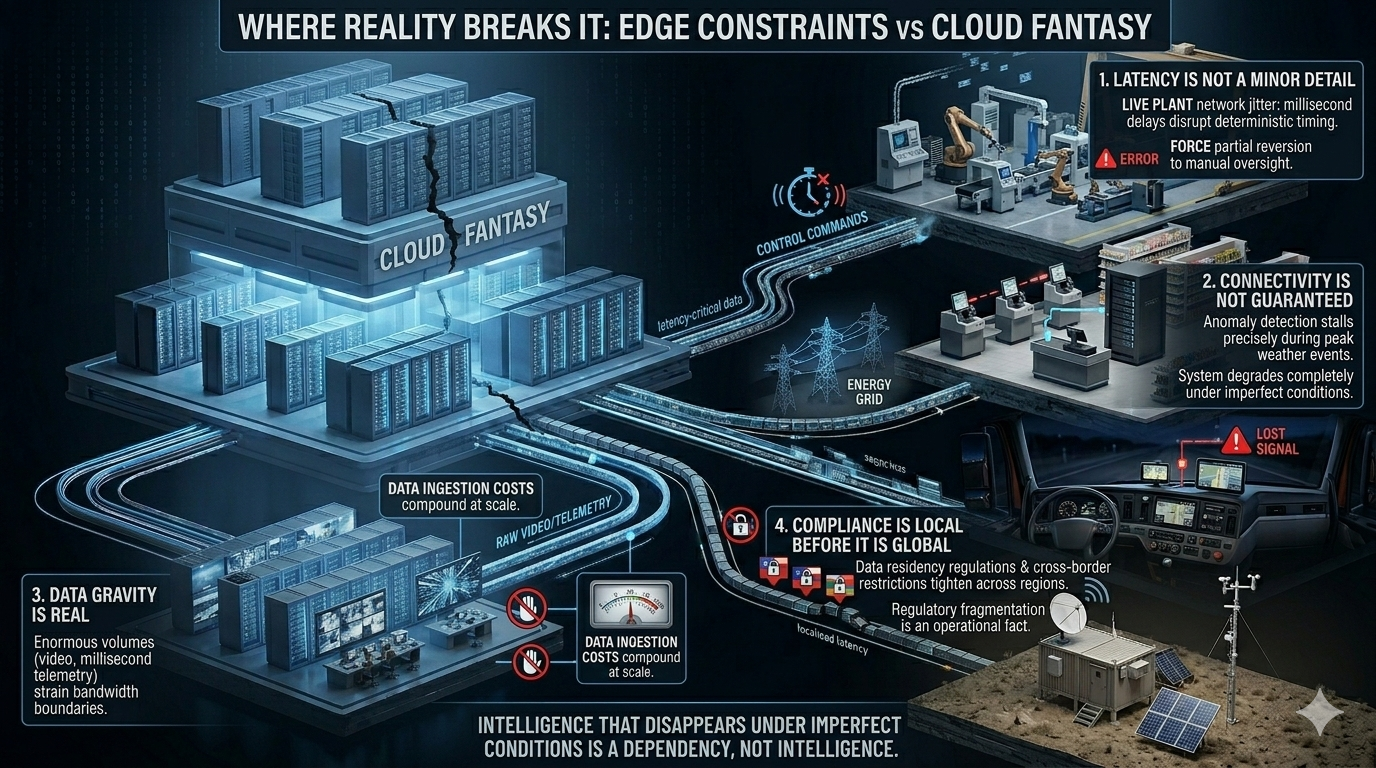
Latency in a production line is not a performance metric. It is a physical constraint. When a vision system is inspecting components at speed and the inference round trip adds inconsistent delay, the feedback loop breaks. The model may be detecting defects accurately. The architecture may be delivering that detection just late enough to be useless.
Connectivity in field operations is not a given. Energy infrastructure, mining sites, agricultural operations these environments do not offer the reliable network that cloud first architectures assume. Several large energy operators discovered this the hard way: anomaly detection systems that depended on continuous cloud inference worked well until the connectivity degraded, which happened to coincide with the peak weather events when anomaly detection mattered most. The system did not degrade gracefully. It stopped.
Intelligence that disappears under imperfect conditions is not intelligence. It is a dependency.
Data volume compounds the problem further. High resolution video streams, millisecond frequency telemetry, sensor fusion inputs the economics of centralising all of this at scale do not hold. And in healthcare or financial services, regulatory frameworks often prohibit the movement of certain operational data across jurisdictions entirely. The architecture cannot route around those constraints. It has to be designed around them from the start.
Global uniformity is an architectural convenience. Regulatory fragmentation is an operational fact.
What Durable Deployments Do Differently
The systems that survive operational environments are not the ones that pushed harder to make cloud first work. They are the ones that stopped treating distribution as a concession and started treating it as the actual design.
Time sensitive inference runs at the edge. Defect detection, safety decisions, on device fraud scoring, predictive maintenance alerts these do not round trip to a centralised model. They cannot. The models are smaller, optimised, purpose built for their environment, and they continue functioning when the network does not.
The cloud does not disappear from these architectures. It shifts roles. Large scale training, cross site pattern learning, fleet wide model updates, governance and drift detection these belong in the cloud because they are coordination problems, not reflex problems. Cloud becomes orchestration. The edge becomes execution.
Hybrid architecture is not a compromise between two preferences. It is an acknowledgement of constraint. Bandwidth is finite. Latency is measurable. Regulation is real. The enterprises getting this right are not the ones with the most sophisticated models they are the ones whose architecture maps honestly onto the environment those models have to operate in.
AI maturity is not measured by how centralised your intelligence is. It is measured by how gracefully it degrades when reality intervenes.
The Test That Matters
There is a practical way to diagnose whether an AI deployment is production ready or demo ready. Ask what happens when the network drops. Ask what happens when latency spikes. Ask which data cannot cross a border and whether the architecture accounts for that.
If the honest answer to any of those questions is that the system stops working, the architecture has not been stress tested against the environment it is supposed to operate in. It has been tested against a controlled environment that resembles it.
That distinction is where most operational AI deployments eventually run into trouble.
The models are usually fine. The infrastructure assumptions underneath them are where things quietly break.
So the question worth sitting with is not whether the cloud can scale your AI. That question has a comfortable answer that vendors are happy to provide.
The harder question is:
Where must intelligence actually exist for this system to remain reliable when the environment stops cooperating?