
Why Most AI Agent Demos Fail in Real Enterprises
AI agents don’t fail because they can’t reason they fail because the environments they are tested in are far more perfect than reality ever is.
Introduction: When Capability Meets Context
AI agent demos are impressive. They plan tasks, reason through steps, and confidently interact with tools and systems. In controlled environments, they often perform remarkably well so well that it’s tempting to believe autonomy is simply a deployment step away.
But when these agents are introduced into real enterprise workflows, something changes.
Not abruptly.
Not dramatically.
But decisively.
And the reason has very little to do with intelligence.
Why Enterprises Are Drawn to AI Agents
The appeal of AI agents lies less in novelty and more in delegation of judgment.
Enterprises are not just looking for faster automation; they are looking to reduce the cognitive load on humans. Agents promise to handle judgment-oriented work planning, coordinating actions across systems, and producing outputs that resemble decisions.
In demos, this appears straightforward. If a system can reason, interpret context, and invoke tools, it feels natural to imagine it operating independently.
That assumption, however, rests on conditions that are rarely discussed.
The Demo Illusion
AI agent demos are designed to succeed.
They run on cleaned, structured data that is often curated specifically for the demonstration. Workflows are predictable, integrations behave as expected, and edge cases are either removed or never introduced.
Under these conditions, agents appear stable and reliable. Their reasoning feels coherent, and their outputs inspire confidence.
Enterprise environments rarely resemble this.
Data is inconsistent and incomplete. Multiple systems disagree. Processes evolve faster than documentation. APIs fail in ways that cannot be anticipated. When agents encounter this reality, their behaviour doesn’t simply worsen, it becomes harder to reason about and harder to trust.
What looks robust in a demo often turns fragile in production.
Most demos don’t reveal this gap because they are not intended to. They prove possibility, not endurance.
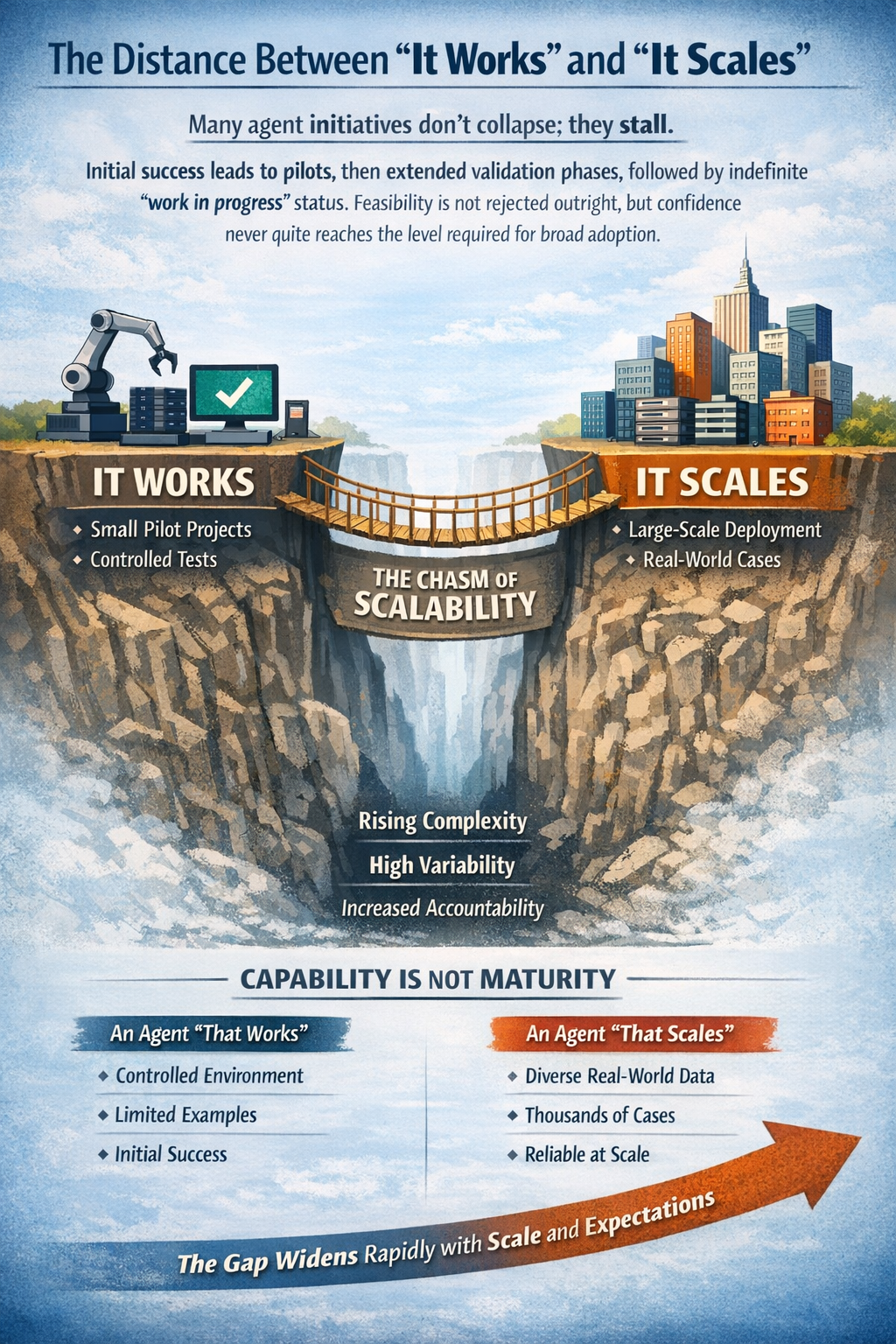
The Distance Between “It Works” and “It Scales”
Many agent initiatives don’t collapse; they stall.
Initial success leads to pilots, then extended validation phases, followed by indefinite “work in progress” status. Feasibility is not rejected outright, but confidence never quite reaches the level required for broad adoption.
The core misunderstanding lies in how teams perceive progress.
An agent that works in a controlled setting demonstrates capability.
An agent that behaves reliably across thousands of real-world cases demonstrates maturity.
The distance between these two states is not incremental, it expands quickly as scale, variability, and accountability increase.
Where Enterprise Reality Applies Pressure
The constraints that matter most rarely appear in demos.
Scalability becomes an issue as data quality varies across teams, regions, and vendors. Volume increases costs in non-linear ways, and edge cases grow faster than safeguards can be implemented.
Usability becomes fragile when similar inputs yield subtly different outputs. Even when results are technically correct, inconsistency erodes human trust, making systems harder to adopt operationally.
Ownership becomes ambiguous once agents influence decisions. When outcomes are poor, responsibility is often unclear and without clear accountability, autonomy remains limited by design.
These forces don’t negate the value of agents. They define the conditions under which that value can exist.
What Actually Works in Practice
The most successful enterprise implementations share a common characteristic: restraint.
Rather than maximizing autonomy, they design agents as contributors within bounded systems. Planning, execution, and enforcement are deliberately separated. Deterministic logic provides stability, while agents assist with interpretation, recommendation, and coordination.
Human involvement is not treated as a fallback but as part of the system’s architecture.
Hybrid models may appear less impressive than fully autonomous demos, but they perform far more reliably under real operational stress. Over time, reliability matters more than sophistication.
The true measure of success is not how intelligent an agent appears, but how consistently it behaves when conditions are imperfect.
That distinction determines whether agents remain experimental or become operational.
The Question Enterprises Need to Ask
Most discussions around AI agents focus on capability.
Can the agent reason?
Can it plan?
Can it operate independently?
In real enterprise environments, those questions are secondary.
The more important question is whether an agent can behave predictably when data is noisy, systems are fragile, and the cost of failure is meaningful. Intelligence without stability rarely earns trust, and trust is the real gatekeeper to adoption.
AI agents don’t fail because they can’t reason. They fail because the environments they are tested in are far more perfect than reality ever is.
Demos optimize for possibility. Enterprises must optimize for survival.
And understanding the difference between the two is where most agent initiatives are ultimately decided.