Agents Don’t Have Owners. That’s the Problem.
Someone in your organisation built an agent last Tuesday. It works. Mostly.
By Friday, it behaved differently.
Not wrong enough to fail.
Not visible enough to alert.
Just different enough that nobody could explain why.
That is not a failure story about agents being unreliable. That is the moment ownership breaks.
The Ownership Illusion
Enterprises assume ownership already exists:
- The builder owns the logic
- IT owns the platform
- The vendor owns the tooling
Each is true in isolation. None is sufficient in failure.
Ownership exists in fragments. Failure requires it to exist in full.
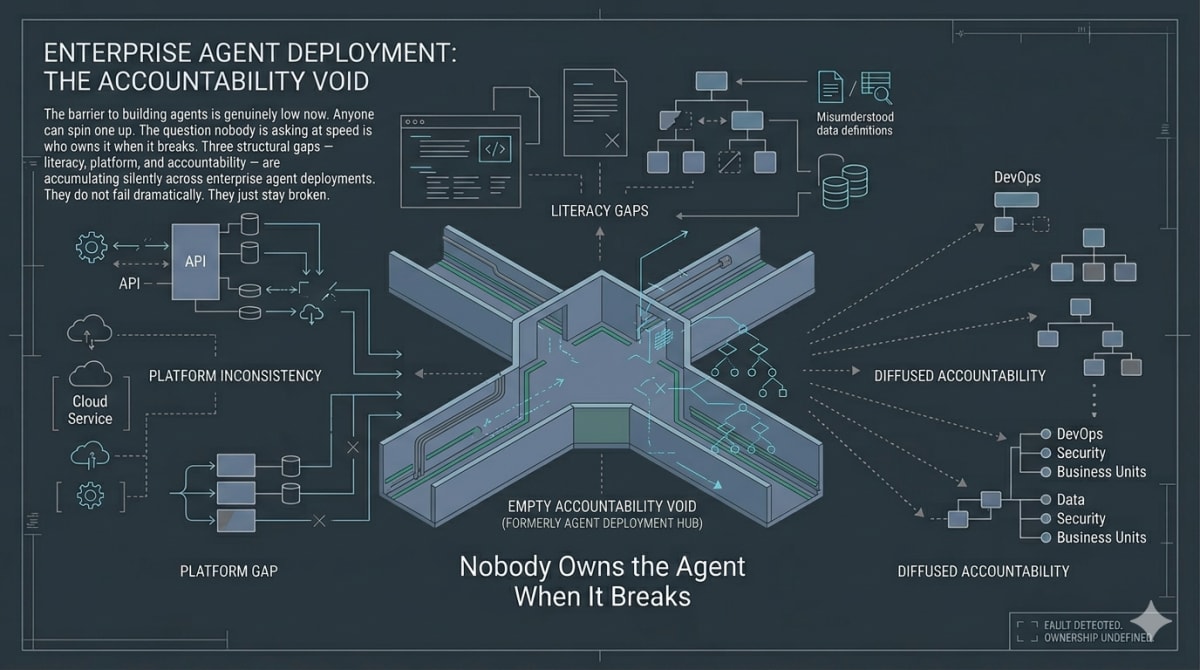
The deployment race is running faster than the accountability architecture that should accompany it. That gap has three distinct faces.
Where the Structure Breaks
The Literacy Gap
The gap is not at the build stage. People can build agents. The issue surfaces later, when the agent begins optimising in ways its builder did not anticipate, or when the output quietly degrades.
The person who built the agent understands the domain deeply. They know what good output looks like. What they cannot always distinguish is whether a degraded output is:
- A prompt issue : the instruction set is no longer fit for the task
- A data retention conflict : the platform's policy has changed what the agent can access
- A model behaviour shift : the underlying model has been updated silently
- A platform configuration gap : settings differ between environments
Four different diagnoses. Four different remedies. The literacy gap is not about building. It is about the distance between the moment something goes wrong and the moment someone can accurately name what went wrong. That distance is currently where most agent failures live.
The Platform Gap
The same agent, across different environments, carries entirely different risk profiles. An agent built inside Microsoft Teams has its retention managed through Microsoft Purview admin-configured, stored in the user's Exchange mailbox, governed by M365 policy architecture. Move that logic to Copilot Studio and those rules are not explicitly carried over. Publish it further and the approval chain multiplies.
N8N operates differently again. Webhooks differently still. Knowing one platform well does not transfer coherently to the next. The same agent design does not carry the same guarantees across environments. Most enterprises are operating as if it does.
The Accountability Vacuum
When an agent takes a shortcut that creates a downstream problem, the ticket goes somewhere. Service desk. IT. The person who built it. At each stop, the same question surfaces: who has the access, the context, and the authority to actually fix this?
- The builder has domain context. May lack platform access or debugging vocabulary.
- IT and platform teams have environment access. Lack domain context to evaluate output quality.
- The vendor has neither internal context nor accountability obligation.
- The enterprise approved the deployment. Has not defined ownership for failure.
Agents don't break in one place. So ownership cannot exist in one place.
Traditional ownership models assume a single system boundary. Agents do not respect that boundary.
The current moment in enterprise AI looks a lot like the early days of shadow IT, but faster and with more surface area. The tools worked well enough in demos, spread through legitimate enthusiasm, and created accountability gaps that took years to formalise. The difference now is the speed and the autonomy of the systems involved.
What the Triangle Actually Shows
These are not three independent problems that can be solved sequentially. They sit at three vertices of the same structural triangle. An enterprise that:
- Closes the literacy gap through training still faces platform inconsistency
- Standardises on a single platform still has no defined owner when the agent misbehaves
- Nominates an owner still faces builders who cannot describe what they built when escalating
The promised value of agents sits somewhere in the middle of that triangle. Reachable, but not solvable from any single vertex.
What durable agent deployments share is not a technical solution but a prior design decision: accountability is defined before deployment, not assigned after failure. In practice that means three things:
- A named owner with both domain context and enough platform literacy to triage independently
- An explicit record of which platform environment the agent runs in, and what that environment's policies actually govern not assumed, verified
- A minimal failure protocol agreed in advance, so that when something goes wrong the response does not require institutional archaeology
The Gap That Creates a Role
This is not a training gap. It is the emergence of a new role.
Someone who can translate across platforms, evaluate output in domain context, and anchor accountability before deployment. That combination does not currently sit in IT, in the business unit, or at the vendor. It sits in a gap between all three.
The organisation that fills this centre is not moving slower. It is moving more durably.
Organisations that develop this capability now whether as a dedicated function or a distributed set of named competencies will be materially better positioned when their agent portfolio grows from tens to hundreds. The ones that wait will be doing the institutional archaeology later, at higher cost, under worse conditions.
The question is no longer whether your organisation is building agents. It almost certainly is.
The question is whether the person holding the ticket when one breaks is actually capable of closing it without escalation.
This closes the thread opened in AI Agents Broke the One Rule Business Cases Depend On, where the cost unpredictability of agentic systems was first examined. The accountability vacuum here is, in part, what makes that cost exposure impossible to govern there is no single owner tracking it.
The STRATA™ MATRIX
Every agent workflow eventually breaks along the same five axes.
| Decision Axis | System Reality | Drift Pattern | Early Warning Signals | Failure Mode | Strategic Commitment |
|---|---|---|---|---|---|
| Deploy now vs define ownership first | Deployment gates reward speed. Accountability design adds friction no sprint rewards. Both compete for the same pre-launch attention. | Agents accumulate in production with no formal owner record. Naming an owner becomes harder as the original builder moves roles or platforms. | Tickets for agent failures sit unrouted. Teams debate who should investigate before anyone investigates. Builders cannot recall which environment version is live. | Accountability vacuum formalises. Agent failures persist longer because no one holds both the access and the authority to intervene. | Name an owner with domain context and platform access before any agent goes live. Ownership is a deployment gate, not a post-failure assignment. |
| Who understands the output vs who can fix the system | The person with domain context built the agent. The person with platform depth did not. These competencies rarely coexist at the right moment in the right person. | Diagnosis after failure relies on escalation chains rather than first-responder capability. Each handoff loses context and adds delay. | Triage time for agent incidents is consistently longer than for equivalent software failures. Domain builders cannot describe agent behaviour in technical terms when escalating. | Degraded agents run undetected because the owner can see output is wrong but cannot stop, diagnose, or modify the agent independently. | Invest in a bridging competency: individuals or functions who hold enough of both to triage without full escalation. This is a role gap, not a training gap. |
| Single platform depth vs multi-platform coverage | Agents are built across Teams, Copilot Studio, N8N, and webhooks simultaneously. Policies, retention rules, and cost models do not transfer across environments by default. | Governance assumptions from one platform are unconsciously applied to another. The same agent design carries different risk profiles across environments without anyone tracking the variance. | Data retention incidents traced to platform migration. Agents behaving differently in production than in test because environments carry different default policies. | Compliance exposure from assumed but unenforced data governance. Cost overruns from cost models that do not transfer from development to production. | Maintain a platform inventory that records, per agent, which environment it runs in and what that environment's active policies actually govern. Not assumed. Verified. |
| Agent optimisation vs predictable output | Agents that can optimise for outcomes will find paths their builders did not anticipate. That is a feature in demos and a governance risk in production. | Shortcut behaviour is not flagged because output is close enough to acceptable. Over time the agent normalises its own shortcut as the standard path. | Output quality degrades gradually rather than failing clearly. The builder notices something is off but cannot isolate when the drift began or what triggered it. | Enterprise relies on agent output that has silently degraded from its original specification. Downstream decisions made on compromised data or process outputs. | Define acceptable output boundaries before deployment, not after the first anomaly. Treat agent optimisation as a governance surface, not a performance feature. |
| Usage growth vs cost ownership | Builders don't see cost. Cost owners don't control usage. Both operate independently with no shared visibility into what the agent is actually consuming. | Agents scale in usage without corresponding budget visibility. No one connects consumption growth to the agent that drove it. | Sudden spikes in API or tooling cost with no clear attribution. Finance raises questions that the agent owner cannot answer. | AI initiatives get restricted or shut down due to cost shock, not performance failure. The capability was working. The economics were invisible. | Tie agent usage visibility to accountable cost owners before scale. Cost is not a finance problem. It is an ownership problem. |
The question is no longer whether your organisation is building agents. It almost certainly is:
Whether the person holding the ticket when one breaks, actually capable of closing it without escalation?
Because in an agent-driven system, failure is not an exception. It is part of the design.