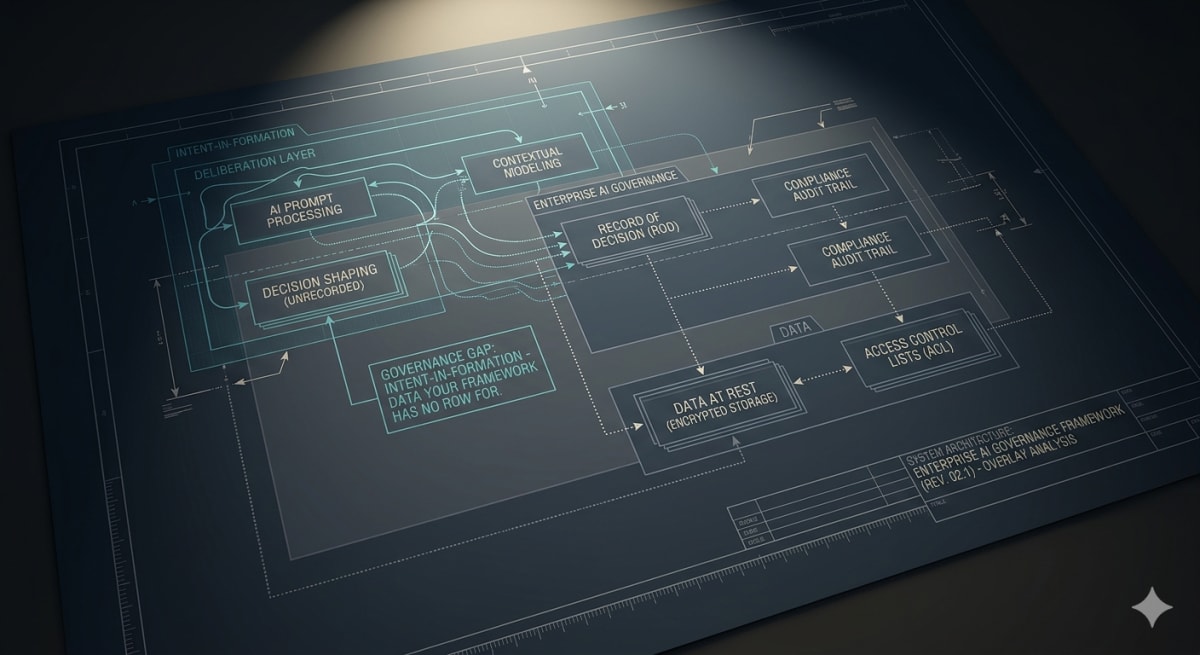
Intent-in-Formation: The Data Your Governance Framework Has No Row For
Someone shared a meme recently. A consultant uploading an entire client brief into an AI tool, just to produce one slide. Everyone laughed. It was funny because it was true. But the laugh ended before anyone asked the obvious question: what does the model now know?
Not what it stored. What it processed.
The Governance Conversation That Is Already Happening
Enterprise AI governance is active, serious, and well-resourced. The risks practitioners are focused on are real:
- Over-permissioned access letting Copilot surface files users were never meant to see
- Misconfigured SharePoint and Teams permissions creating unintended data exposure
- Sensitivity labels missing or misapplied, so confidential content is treated as general
- Prompt injection vulnerabilities allowing malicious inputs to extract tenant data
Microsoft's documentation is explicit on the policy layer: prompts and responses are not used to train foundation models, data stays within the tenant boundary, retention policies apply. The governance conversation is not absent. It is organised, well-documented, and largely trusted by enterprise buyers.
That is precisely the problem.
A well-organised governance conversation pointed at the wrong category of data does not produce gaps you can see. It produces gaps that feel like coverage.
The Category Nobody Has Named
Traditional data governance operates on a clear taxonomy. Three categories, well understood:
- Data at rest. Files stored, classified, labelled, retained.
- Data in motion. Information moving across systems, encrypted, logged.
- Data in use. Active processing, access-controlled, auditable.
Every major governance framework, NIST, ISO 42001, EU AI Act, is built on some variation of this taxonomy. Every Copilot governance checklist enterprise teams are running right now maps to one of these three.
None of them have a name for what I would call intent-in-formation.
A consultant stress-testing three acquisition scenarios before recommending one. A partner modelling workforce reductions before any direction has been approved. A team drafting a restructuring pitch that may never be executed. This is not data at rest. It carries no sensitivity label. It does not appear in a permission audit. It has not been decided, documented, or stored in any meaningful sense.
Traditional governance governs what was decided. Enterprise AI now processes what is still being considered. Those are not the same category, and only one of them has a governance framework.
In consulting environments the gap is structurally visible. The client wants faster delivery. The offshore team needs to solve the problem before the next check-in. Copilot is bundled into the Microsoft 365 license everyone already runs. Speed wins. The tool gets used. The deliberation moves through the system.
And the governance team asks about permissions, retention, and sensitivity labels, all correctly, for a category of data that is not the one flowing through the system right now.
When the Model Arrives Before the Decision
Every accountability model currently in use rests on a sequence: the human thinks, the system records or supports. That sequence is load-bearing. It is the foundation on which decision rights, audit trails, and accountability structures are built.
Enterprise AI at scale has quietly broken that sequence. The model is now present in the deliberation itself, structuring arguments before they become recommendations, shaping option sets before they become decisions. Not making decisions. Something more subtle: narrowing the space in which decisions form.
When that sequence breaks, the accountability question changes. It is no longer: who is responsible for this decision? It becomes: where did this decision actually begin?
We have built accountability frameworks for AI that acts after the human thinks. We have not built frameworks for AI that is present while the human thinks.
The Accountability Chain Nobody Has Drawn
In a standard consulting engagement running on enterprise AI tools, the chain looks like this:
- Client asks about data access controls and residency.
- Consulting firm asks about retention policies and sensitivity labelling.
- Platform vendor points to contractual commitments and service boundaries.
- Model processes the prompt and returns a response.
Every node is answering correctly. Nobody has asked the question the situation has actually produced: which node is responsible for the category of organisational thinking that moved through this system before it became a decision?
The answer is not that everyone is responsible. The answer is that intent-in-formation does not appear in the accountability architecture at all. It is not ungoverned because someone failed to govern it. It is ungoverned because the governance taxonomy does not yet contain it.
What STRATA™ surfaces here is not a vendor risk or a storage risk. It is a categorical risk: governance frameworks are not failing. They are operating with complete accuracy on a taxonomy that is no longer sufficient.
What Durable Governance Does Differently
Organisations beginning to close this gap are asking a prior question before reaching for a framework: have we named every category of organisational information now moving through AI systems, or only the categories that existed before AI was in the room?
That question does not appear on most governance checklists. It probably should be the first item.
Because the current state looks like this:
- The audit trail is clean.
- The sensitivity labels are applied.
- The retention policy is compliant.
- The permission model has been reviewed.
And somewhere in the deliberation layer, in the options nobody chose, the scenarios nobody approved, the strategies that never became announcements, sits a category of organisational intelligence that governance has not yet learned to see.
The meme was funny. Everyone laughed at the inefficiency. The governance gap does not get a meme. It gets a clean audit report.
The most dangerous governance blind spot is not the one your framework flags as a risk. It is the one your framework has no row for.